Unatafuta Nini?


When buying nurse uniforms, the terms suppliers throw around are getting fancier and fancier—"silver-ion antibacterial," "bamboo fibre naturally inhibits bacteria," "nano antibacterial finishing," "AAA-grade antibacterial" … each one sounding more advanced than the last, and the price climbing accordingly. The same nurse uniform with an "antibacterial" label costs dozens or even over a hundred yuan more than a standard version.
So here's the question: are these antibacterial functions genuinely useful, or just a gimmick manufacturers use to raise prices?
The answer is: the antibacterial function itself is real, but a large number of "antibacterial nurse uniforms" on the market do not achieve the effects they claim. The key isn't the phrase "antibacterial" – it's how the antibacterial effect is achieved, how long it lasts, and how much remains after dozens of washes. Today, we're going to break down antibacterial nurse uniform fabric in detail.
1. First, understand: why do nurse uniforms need antibacterial properties?
Ordinary workwear doesn't place much emphasis on antibacterial performance. Nurse uniforms are different.
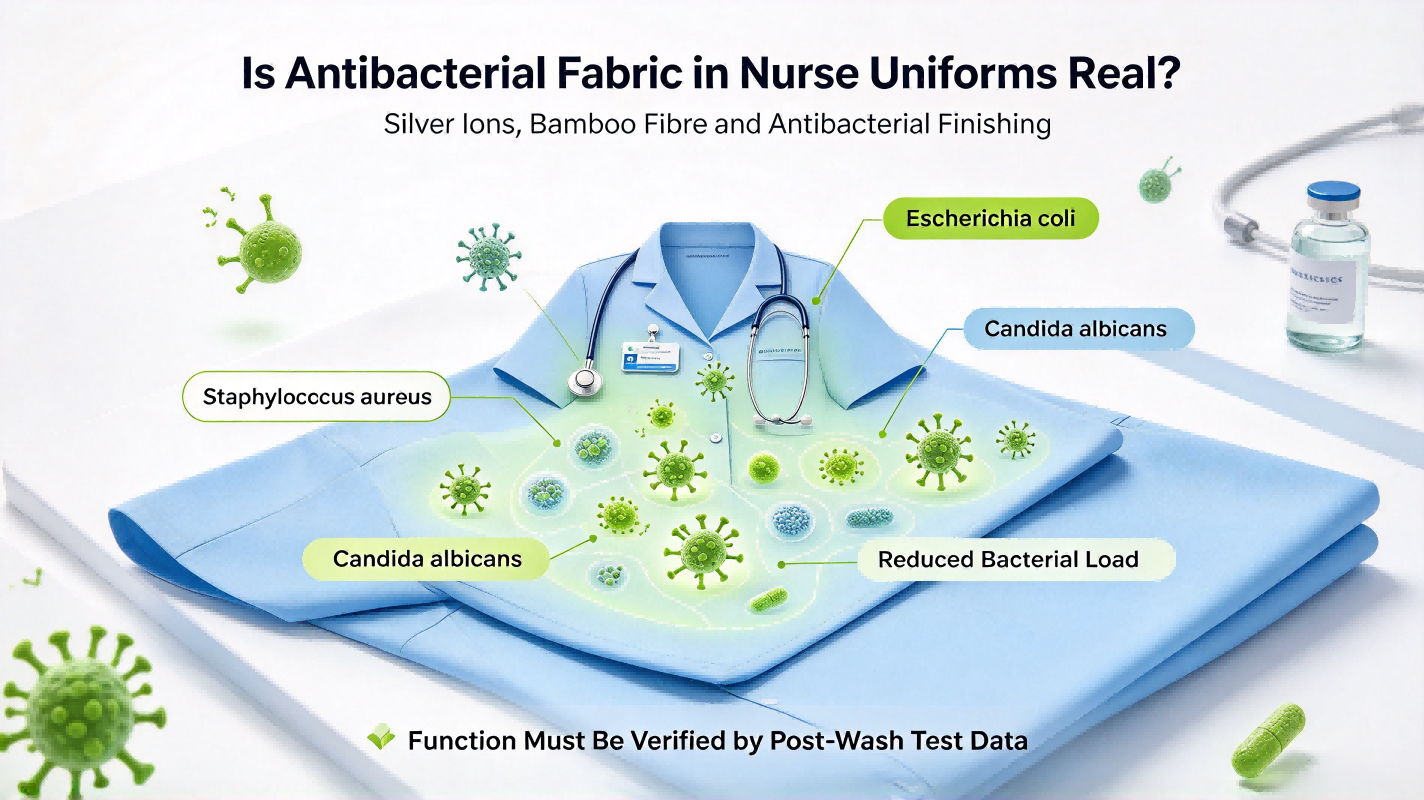
Nurses come into contact with patients, body fluids, and secretions every day. Nurse uniform surfaces can easily pick up pathogenic bacteria such as Staphylococcus aureus and Escherichia coli. These bacteria survive and multiply on fabric and can become a vector for cross-infection within hospitals. The core purpose of antibacterial nurse uniforms is to inhibit bacterial multiplication on the fabric surface, reduce the risk of cross-infection, and also reduce odours caused by bacteria breaking down sweat and sebum.
So antibacterial nurse uniforms aren't just a "nice extra." In departments such as ICU, emergency, infectious diseases, and operating rooms, they are part of the infection control system.
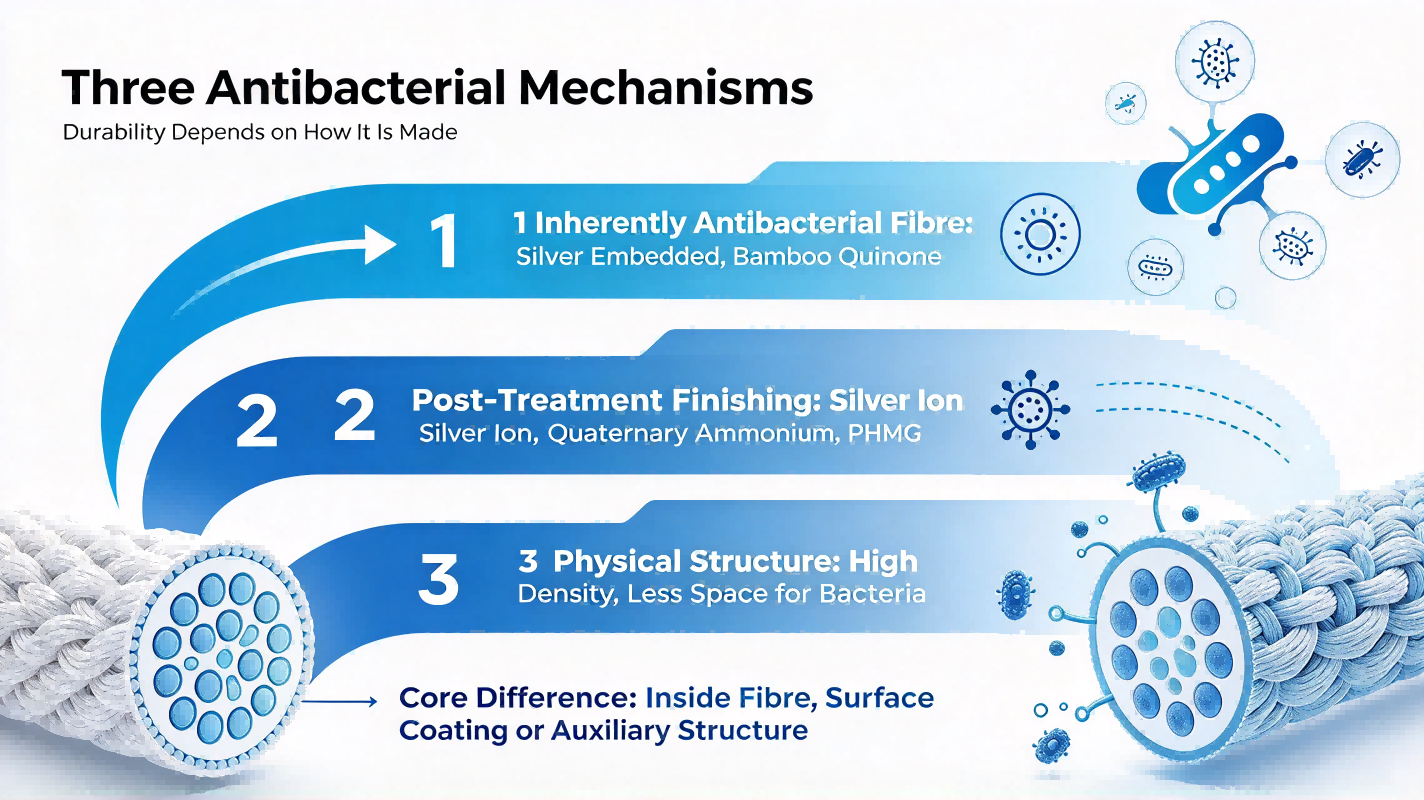
2. Antibacterial function in nurse uniforms is achieved in three ways—with vastly different durability
Antibacterial fabric isn't a single material—it's a category of functions. Different routes to antibacterial performance mean very different effectiveness and lifespan.
Method 1: Inherently antibacterial fibres – most durable, but limited options
Some fibres are inherently antibacterial. For example, bamboo fibre naturally contains "bamboo quinone"-type antibacterial components and doesn't require added antibacterial agents; chitosan fibre also has intrinsic antibacterial ability. Silver-based antibacterial fibres embed nano-silver or silver ions inside the fibre during spinning, making the antibacterial component part of the fibre itself.
The biggest advantage of this approach is durability. The antibacterial component is inside the fibre, not attached to the surface, so it doesn't wash out easily. Nurse uniform fabric using silver-ion-embedded fibres can withstand 50 to 100 hospital-standard washes without a significant drop in antibacterial rate.
But natural antibacterial fibres have limited antibacterial spectrum and strength. Bamboo fibre's inhibition rate against Staphylococcus aureus and Escherichia coli is roughly in the 50% to 70% range – not as strong as silver-based agents. Silver-based fibres have strong antibacterial power but are costly, and the safety of silver ions needs attention (discussed later).
Method 2: Post-treatment antibacterial finishing – most common, but "gone after a few washes" is the biggest risk
This is the method used by the vast majority of "antibacterial nurse uniforms" on the market: applying a layer of antibacterial finishing agent (silver-ion finishing agent, quaternary ammonium compounds, PHMG, etc.) to ordinary fabric to give the surface antibacterial ability.
The advantage of post-treatment is low cost and broad applicability – cotton and poly-cotton can both be treated. But its fatal weakness is inconsistent durability.
Ordinary post-treatment antibacterial layers degrade noticeably after a dozen or even a few washes, and the antibacterial function essentially drops to zero. The statement that 35% of antibacterial fabrics on the market fail wash-durability requirements mainly refers to this type of product. Better graft-type post-treatment technologies can maintain antibacterial effects after 200 washes, but this is the craftsmanship level of a minority of manufacturers, not an industry-wide norm.
Method 3: Physical structure antibacterial – auxiliary means, cannot be used alone as an antibacterial function
Hig-density woven fabric has smaller gaps between yarns, making it harder for bacteria to colonise and multiply inside the fabric. Tightly woven fabric with a warp and weft density of 300 threads per square inch or more can provide some physical bacterial resistance.
But physical structure antibacterial is auxiliary – it reduces the space for bacteria to attach and hide; it cannot actively kill bacteria. Marketing it as an "antibacterial function" is at best a bonus point, not a core selling point.
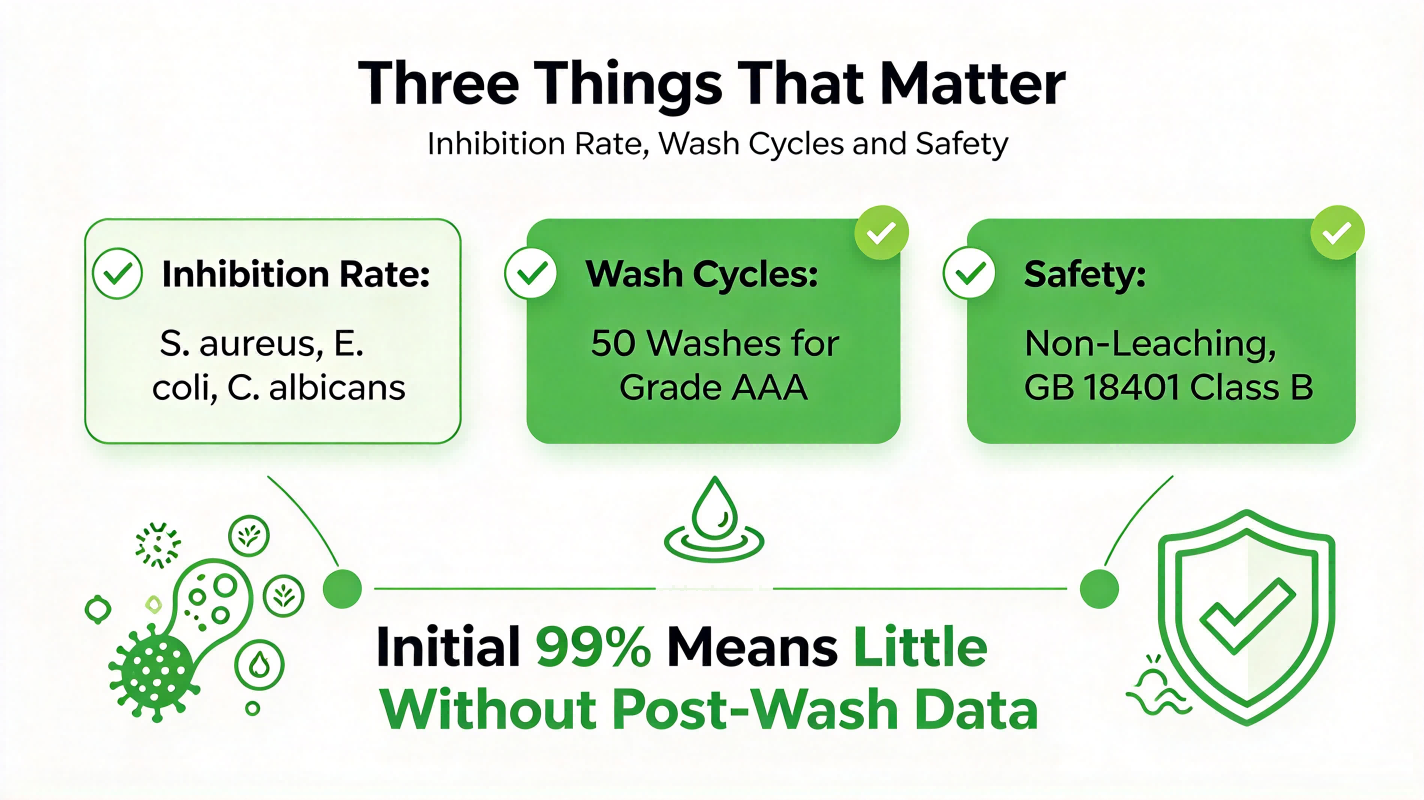
3. To judge whether antibacterial claims are real, look at three things: inhibition rate, wash cycles, and safety
"Antibacterial" isn't an on/off switch. It's a technical indicator with specific values, tested bacterial strains, and washing conditions. To judge whether an antibacterial nurse uniform is reliable, look at three things.
First: inhibition rate – against which bacteria, and at what level
Antibacterial isn't a vague "inhibits bacteria" – it's a quantified result against specific strains. Nurse uniform antibacterial testing usually assesses three representative strains: Staphylococcus aureus (Gram-positive), Escherichia coli (Gram-negative), and Candida albicans (fungus).
According to the GB/T 20944 series of standards, when using the oscillation method (for non-leaching antibacterial products), an inhibition rate of ≥70% against Staphylococcus aureus and Escherichia coli and ≥60% against Candida albicans is judged as having antibacterial effect. If a supplier claims "good antibacterial effect," it usually needs to reach ≥90% or higher.
There's a big gap between "passing" and "excellent." An inhibition rate of 70% versus 99% represents a completely different level of protection in real-world use.
Second: wash cycles – this is the Achilles' heel of antibacterial nurse uniforms
Nurse uniforms are washed two or three times a week, and also go through high temperature and chlorine disinfection. If the antibacterial effect is gone after a dozen washes, it might as well not exist.
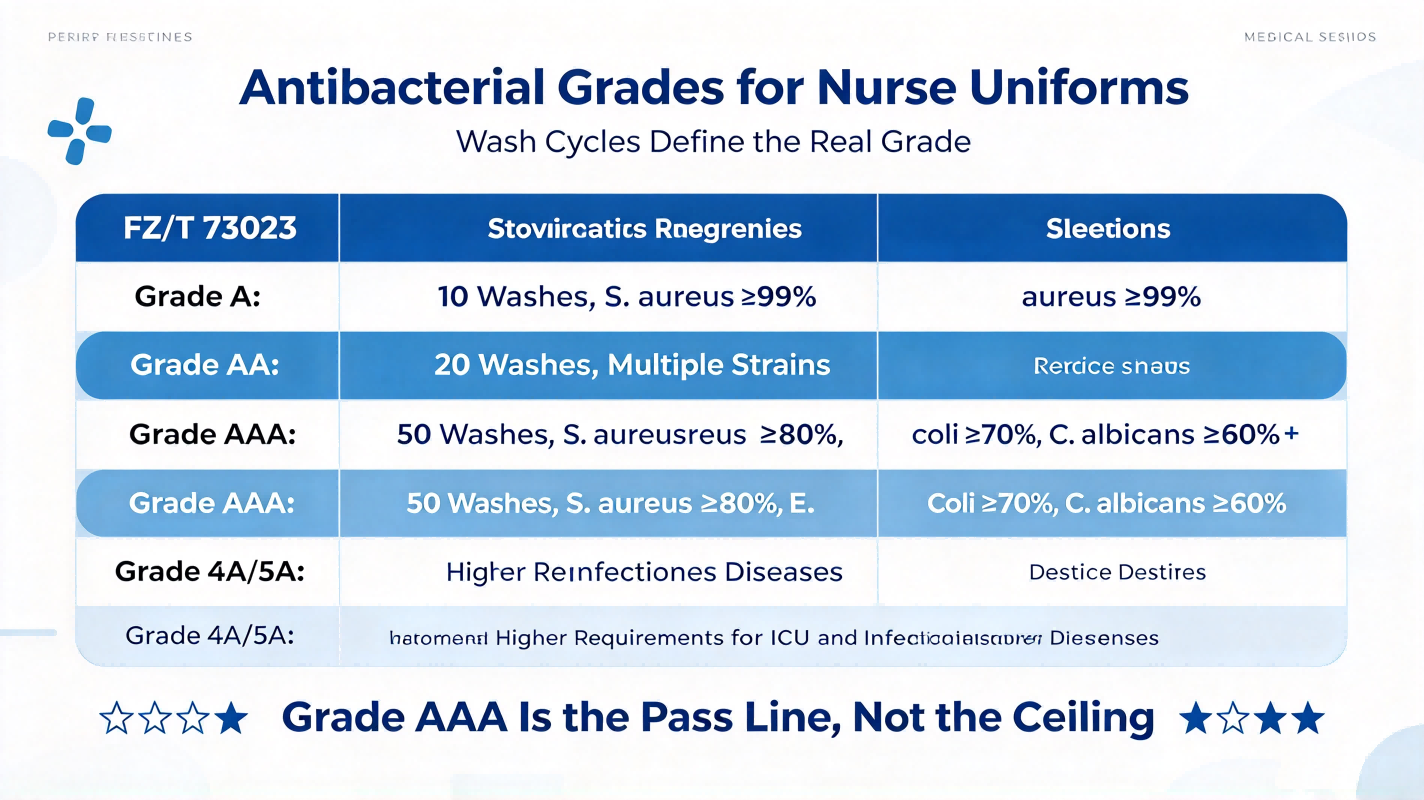
Industry standard FZ/T 73023 "Antibacterial Knitwear" uses wash cycles to classify antibacterial grades, which is most relevant for nurse uniforms:
|
Antibacterial grade |
Wash cycles assessed |
Staphylococcus aureus |
Escherichia coli |
Candida albicans |
|
Grade A |
10 washes |
≥99% |
Not required |
Not required |
|
Grade AA |
20 washes |
≥80% |
≥70% |
≥60% |
|
Grade AAA |
50 washes |
≥80% |
≥70% |
≥60% |
Data source:
Grade AAA is the pass line for nurse uniforms, not the ceiling. It means that after 50 washes, the antibacterial effect still meets the standard. The 2026 revision of FZ/T 73023 also adds Grade 4A and Grade 5A: Grade 4A requires that after 50 washes, inhibition rates against both Staphylococcus aureus and Escherichia coli are ≥90%, and against Candida albicans ≥80%; Grade 5A requires that after 50 washes, inhibition rates against Staphylococcus aureus and Escherichia coli are ≥99%, and against Candida albicans ≥85%. For departments with high infection control requirements such as ICU and infectious diseases, Grade 4A or even Grade 5A is what has practical significance.
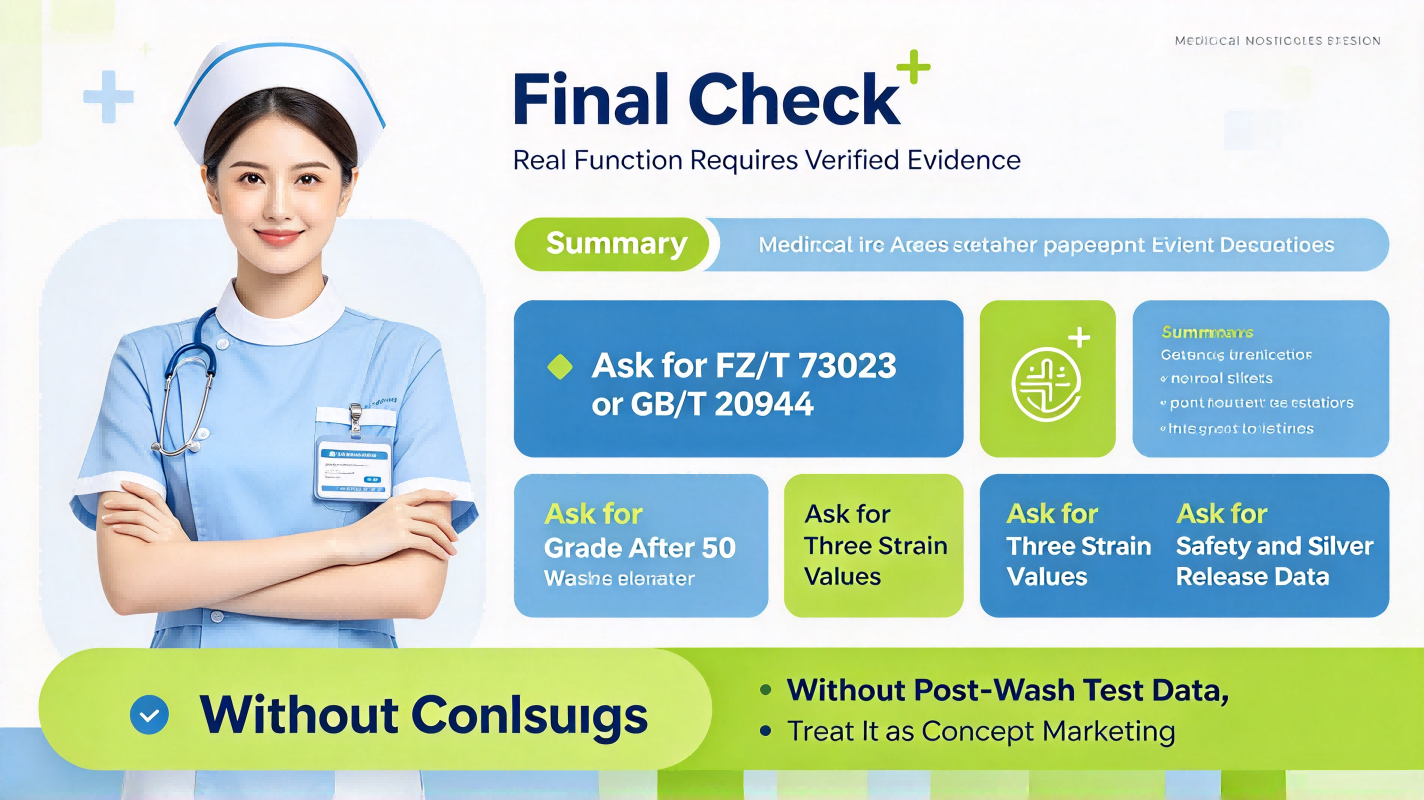
Ask directly during procurement: What antibacterial grade is it—how many A's? Do you have a test report after how many washes? If they only provide an "initial antibacterial rate 99%" report and cannot produce post-wash data, you can basically conclude durability is inadequate.
Third: safety—will the antibacterial agent "leach out"?
This point is most easily overlooked, but for nurses who wear the garment against their skin 8 to 12 hours a day, it's crucial.
Antibacterial agents are divided into leaching and non-leaching types. Leaching antibacterial agents (such as some silver-ion finishing agents) slowly release antibacterial components onto the skin surface and into the environment during use. While killing bacteria, they may also cause skin irritation and raise the risk of bacterial resistance. Non-leaching antibacterial agents are fixed on or inside the fibre surface and do not actively release, offering relatively higher safety.
According to FZ/T 73023 requirements, the leaching D value of antibacterial knitwear should be <6 mm, and antibacterial agent residues must comply with safety specifications, with heavy metal content (such as lead) controlled within limits. The 2025 revision of GB/T 20944.3 also added a requirement of nano-silver limit ≤1000 μg/g, drawing a safety boundary for the use of silver-based antibacterial agents.
Nurse uniforms must first meet the basic safety requirements of GB 18401 Class B (direct skin contact). Antibacterial function is layered on top of that foundation—it must not come at the expense of safety.
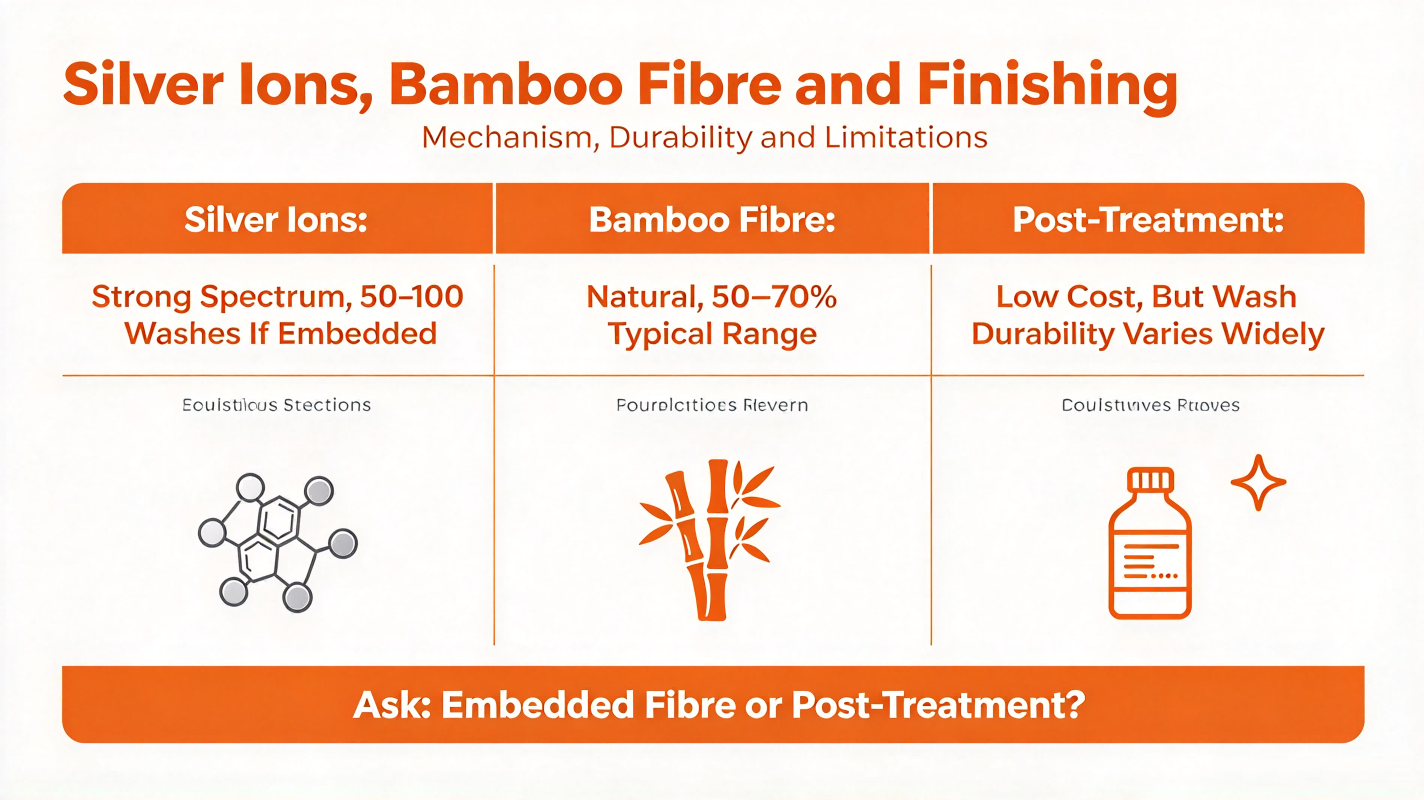
4. Silver ions, bamboo fibre, antibacterial finishing – how to choose?
Silver ions (including nano-silver): strong antibacterial power, but ask clearly "where" and "how much"
Silver ions have a clear antibacterial mechanism and can achieve inhibition rates of over 99% against Staphylococcus aureus and Escherichia coli, with a broad spectrum and fast action.
But the form in which silver ions exist determines durability. Silver-based antibacterial fibres with silver embedded inside the fibre have good wash resistance, with stable performance after 50 to 100 washes. Silver-ion coatings applied by surface post-treatment, however, may wash out substantially after a few washes. At the same time, the amount of silver ions released needs to be controlled—excessive silver release may irritate the skin, which is why the new national standard added a nano-silver limit.
When choosing silver-ion antibacterial nurse uniforms, ask two questions: Is it embedded fibre or post-treatment? Do you have a test report for silver-ion release?
Bamboo fibre: good natural concept, but limited antibacterial power – don't be misled by the word "natural"
Bamboo fibre's "natural antibacterial" property is real—bamboo quinone-type components have an inhibitory effect on some bacteria. But natural doesn't mean potent. Bamboo fibre's antibacterial performance is roughly in the 50% to 70% range. For nurse uniforms, which need to deal with multiple pathogens and frequent washing, natural antibacterial power alone is often insufficient.
If a nurse uniform is marketed as "bamboo fibre antibacterial" but doesn't provide specific inhibition rate data against Staphylococcus aureus, Escherichia coli, and Candida albicans, nor post-wash test reports, then its "antibacterial" claim is more of a material story than a verifiable functional indicator.
Post-treatment antibacterial: most common, and most in need of scrutiny on "wash resistance"
Post-treatment antibacterial is the most common solution on the market – cost-controllable, and applicable to both cotton and poly-cotton. But precisely because the barrier to entry is low, product quality varies widely. With the same post-treatment, ordinary processes degrade after a dozen or so washes, while good grafting processes can maintain antibacterial effects after 200 washes.
When choosing post-treatment antibacterial nurse uniforms, the only credible basis is a third-party test report after washing. The report should show three things: the execution standard (GB/T 20944 or FZ/T 73023), the bacterial strains assessed and inhibition rates, and the number of washes. If any one is missing, the antibacterial claim should be discounted.
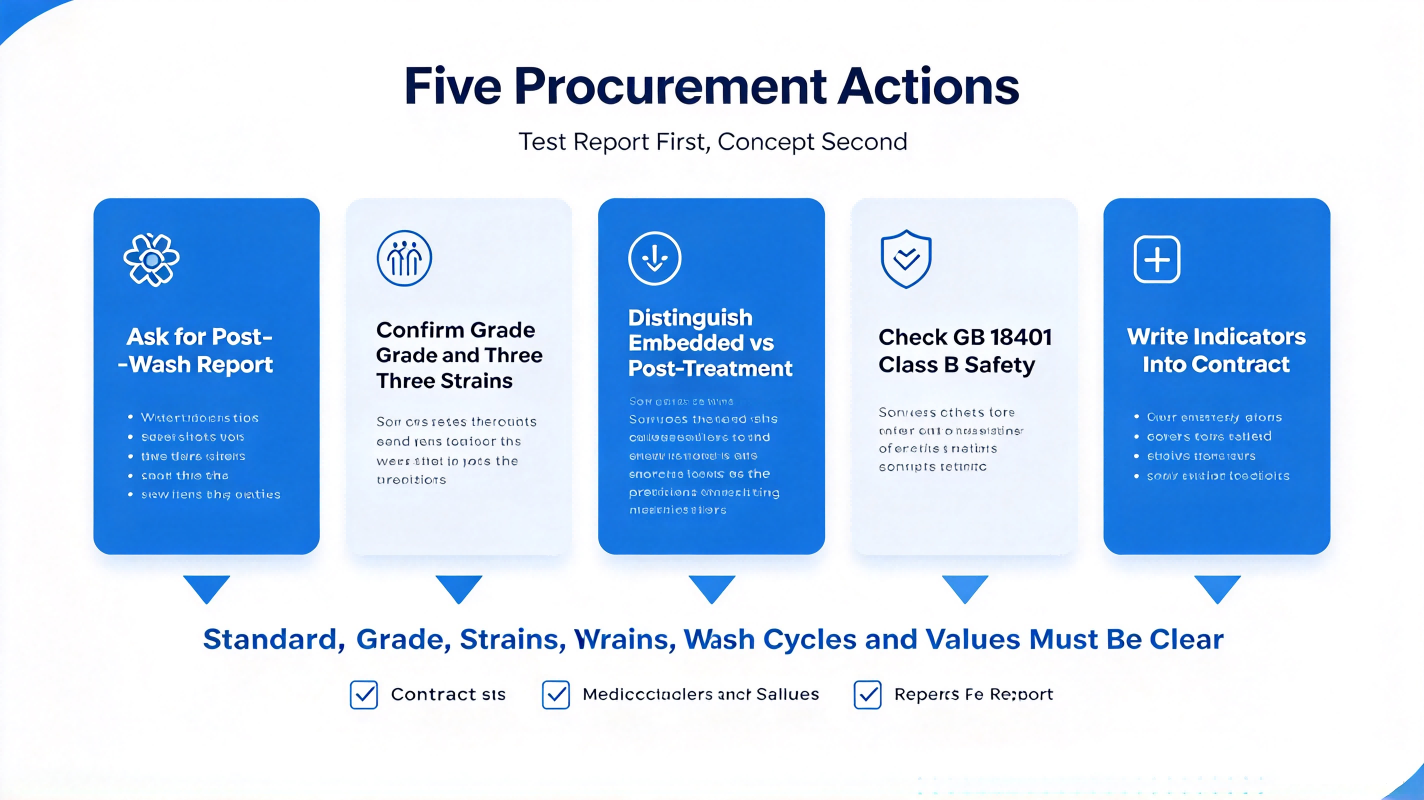
5. Five practical actions during procurement
Action 1: Ask for "post-wash" test reports, not just initial data. An initial inhibition rate of 99% isn't hard to achieve; what's hard is still meeting the standard after 50 washes. The report must clearly state the number of washes and the inhibition rate after washing.
Action 2: Confirm the antibacterial grade and strains assessed. Nurse uniforms should preferably reach at least FZ/T 73023 Grade AAA (50 washes). For high infection-control departments (ICU, infectious diseases, operating rooms), look for Grade 4A or 5A test data. Inhibition rates for all three strains (Staphylococcus aureus, Escherichia coli, Candida albicans) should be provided – not just one.
Action 3: Distinguish the antibacterial method and durability logic. For embedded fibre antibacterial, ask "inside the fibre or on the surface?" For post-treatment antibacterial, ask "how many washes does it withstand?" For bamboo fibre, ask "what are the specific inhibition rate data?" If they can't answer clearly, treat it as "concept antibacterial."
Action 4: Check the safety baseline. Antibacterial nurse uniforms must first be GB 18401 Class B. For silver-based antibacterial, additionally check the nano-silver limit or silver-ion release test; for post-treatment antibacterial, check the safety report of the antibacterial agent (skin irritation, heavy metal residue).
Action 5: Write antibacterial indicators and washing conditions into the contract. Don't just write "antibacterial nurse uniforms." Specify clearly: execution standard (e.g. FZ/T 73023), antibacterial grade (e.g. Grade AAA), strains assessed and inhibition rates, and wash cycles (e.g. 50 washes). During bulk sampling, send samples to a third party for testing against the contract indicators; treat failures as breach of contract.
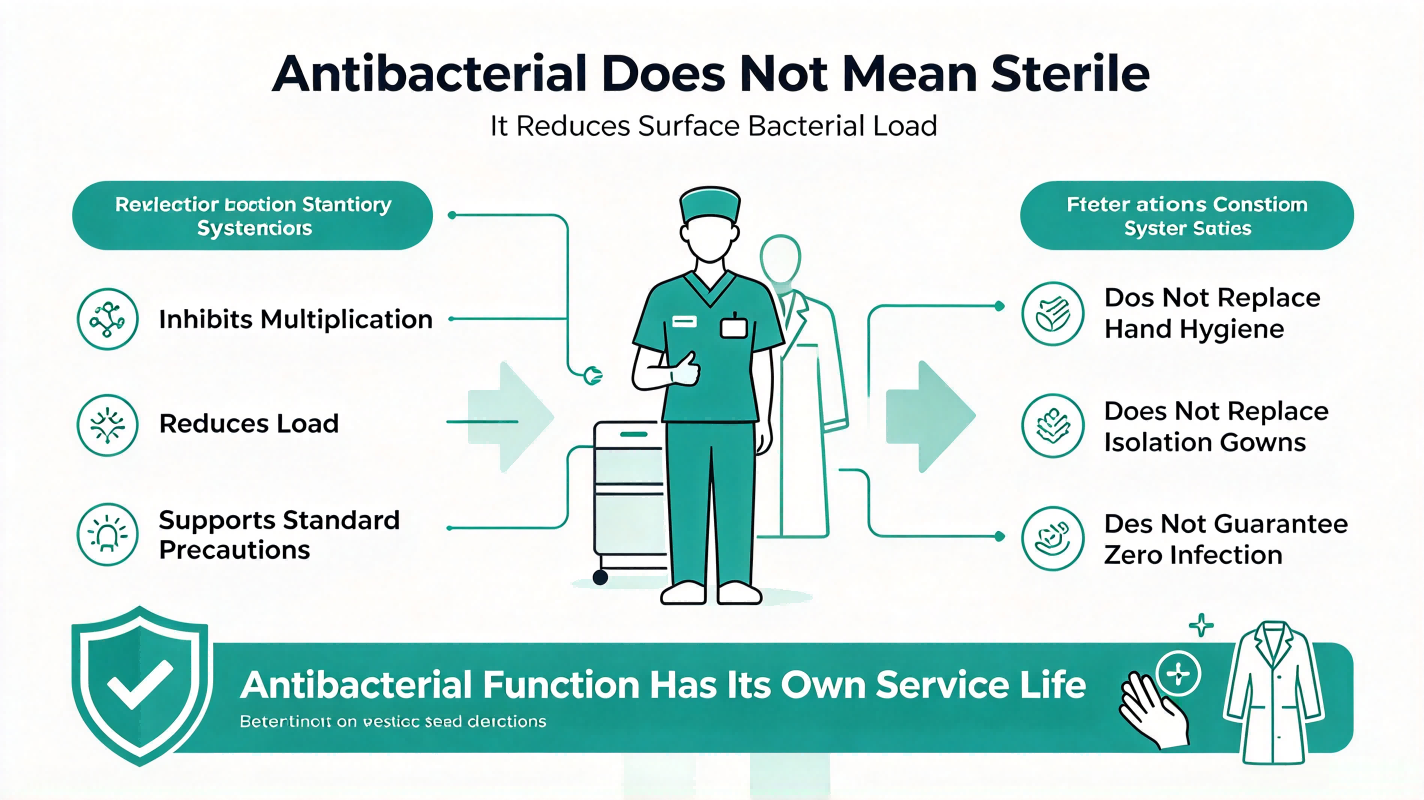
6. One reality that must be made clear: antibacterial does not mean sterile, and does not mean infection-proof
The role of antibacterial nurse uniforms is to inhibit bacterial multiplication on the fabric surface and reduce bacterial load. They are not disinfectant garments and cannot replace hand hygiene, isolation gowns, or standard precautions. Antibacterial function is an auxiliary part of the infection control system, not a talisman that means "wear it and you won't get infected."
Likewise, "Grade AAA antibacterial" doesn't last forever. Fifty washes is the assessment point; beyond that, antibacterial performance may continue to decline. Nurse uniforms themselves have a service life, and antibacterial function has a service life too – both need to be considered together.
A final honest word
The antibacterial function of nurse uniforms is not a gimmick. Silver ions, bamboo fibre, and post-treatment antibacterial finishing all have real textile technology behind them, and all have corresponding national standards to verify. The problem is that the word "antibacterial" has been used far too casually – an initial inhibition rate of 99% and it's called antibacterial; failing after a dozen washes and it's still called antibacterial; testing only one strain and it's still called antibacterial.
There is only one core way to judge whether it's real: look at the third-party test report after washing—the execution standard, the antibacterial grade, the strains assessed, and the inhibition rate values. If they can produce it, keep talking. If they can't, be very cautious no matter how low the price.
Next time a supplier says "our nurse uniforms are antibacterial," ask them directly: "Does it follow FZ/T 73023 or GB/T 20944? What antibacterial grade—how many A's? After 50 washes, what are the inhibition rates against Staphylococcus aureus, Escherichia coli, and Candida albicans? Can I see the report?" – A supplier who can answer these questions is a supplier who has genuinely made antibacterial nurse uniforms.